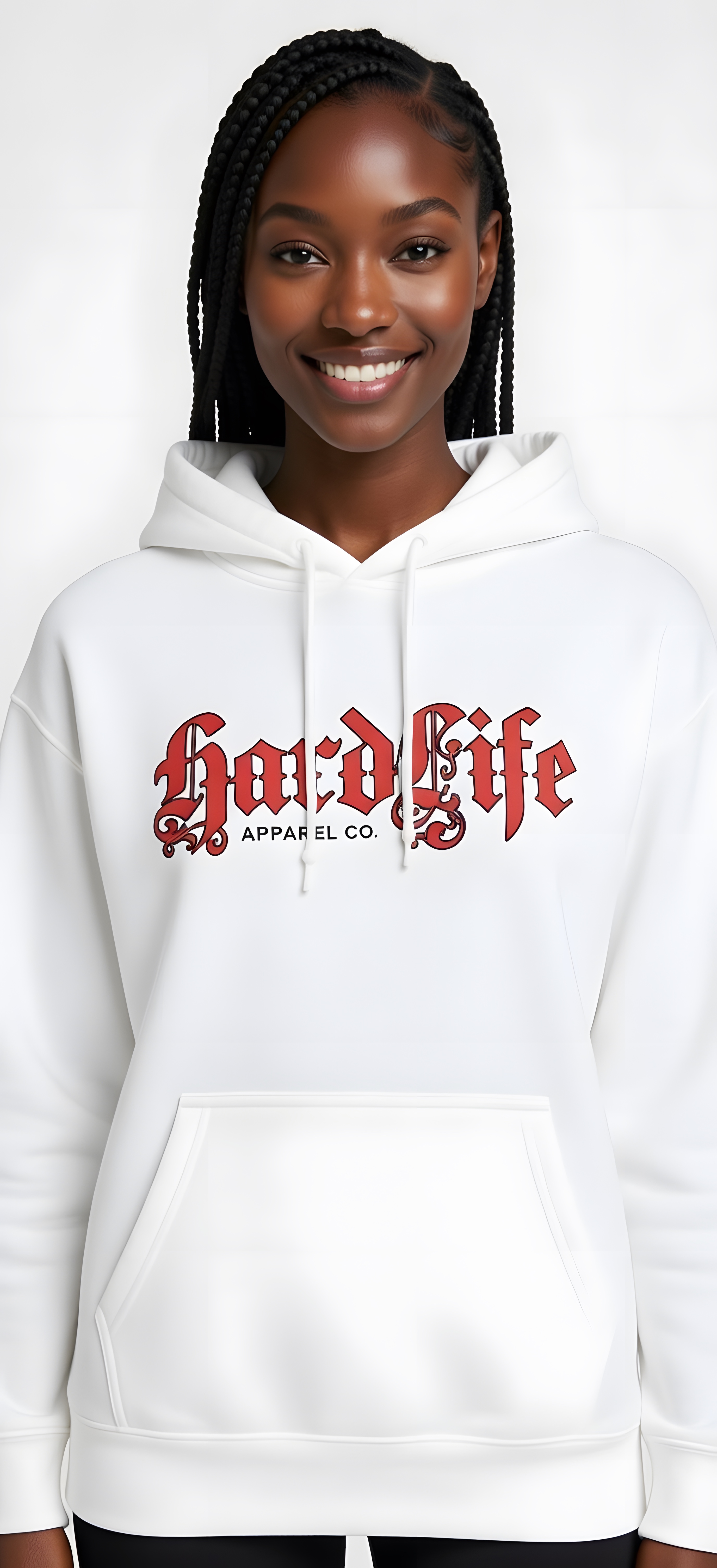
There’s a typeface you’ve seen your entire life without ever being taught to read it. On the chest of someone’s hoodie at the skatepark. Tattooed across a set of knuckles. Stenciled on a wall in a city alley. Printed across the back of a jersey at the bottom of the ninth inning. It’s ornate, angular, sometimes barely legible — and it communicates something instantly, long before you’ve made out a single letter.
This is blackletter, also called Old English, Gothic script, or Fraktur depending on the variant and the context. It is simultaneously one of the oldest typefaces in Western printing history and one of the most alive visual languages in contemporary street culture. That’s a strange combination. Understanding how it happened tells you something important about how culture actually moves — not in straight lines, but in loops and reversals and unlikely inheritances.
Where It Came From
Blackletter didn’t begin on a street corner. It began in the scriptorium — the monastery writing room where medieval scribes spent their days copying manuscripts by hand. By the 12th century, a compressed, angular style of writing had emerged as the dominant hand in Western Europe, valued for the density of text it could fit on expensive vellum pages. This was blackletter: named for the heavy weight of ink that darkened the page.
When Johannes Gutenberg built his printing press in the 1450s, he didn’t design his movable type to look like anything new. He designed it to look like what scribes already produced — which meant blackletter. His 42-line Bible, printed around 1455, is set in a blackletter typeface. For the next two centuries, blackletter was the standard European type for serious printing, the visual signature of authority, religion, and scholarship.
“Blackletter is simultaneously one of the oldest typefaces in Western printing history and one of the most alive visual languages in contemporary street culture.”
By the 17th century, Roman typefaces — the cleaner, rounder letterforms we now think of as standard — had displaced blackletter across most of Europe. England moved to Roman type. France moved on. Germany held on to Fraktur longer than most, well into the 20th century. But everywhere, the typeface retreated from the mainstream.
It did not disappear. It went underground — where it found new life.
The American Street Adoption
Blackletter’s route into American street culture runs through several channels simultaneously, and tracing any single origin misses the complexity of how visual languages actually propagate.
One major vector was the newspaper masthead. For most of American history, major newspapers used Old English-style blackletter for their titles — a visual signal of tradition and authority. The Los Angeles Times, the New York Daily News, the Chicago Tribune: all blackletter mastheads. When gang culture in Los Angeles began developing its visual language in the mid-20th century, this typography was already saturating the environment. The newspaper style communicated permanence, seriousness, the weight of record. It was available to be repurposed.

Southern California gang lettering, particularly from Chicano gang culture, was one of the most significant transmitters of blackletter aesthetics into broader American street culture. The elaborate calligraphic style that emerged from that context — often called “cholo lettering” or “placa” — brought Old English script into a completely new visual environment. This wasn’t imitation; it was transformation. The letterforms were adapted, stretched, recombined, and made to serve entirely different communicative functions.
From there, the cross-pollination accelerated. Hip-hop culture adopted blackletter as part of its typographic vocabulary in the 1980s and 1990s. Tattoo culture, which had long maintained its own independent relationship with the letterform, became another transmission vector. When skateboarding and streetwear began developing distinct aesthetic identities in the same period, they drew from all of these streams at once.
Graffiti and the Typographic Laboratory
If any single subculture served as the incubator for blackletter’s transformation into a street art medium, it was graffiti writing. Beginning in New York in the late 1960s and spreading globally through the 1970s and 1980s, graffiti culture turned letterform design into a competitive discipline.
Writers were primarily interested in letters — how they could be stretched, merged, decorated, bombed into illegibility or engineered into crystalline precision. Blackletter’s inherent complexity made it a natural reference point. Its thick downstrokes and hair-thin serifs provided structural scaffolding that writers could work with, distort, and evolve. Cities like Philadelphia, with strong graffiti traditions going back to the 1970s, developed regional styles that left marks on how blackletter was used and understood.
“Graffiti culture turned letterform design into a competitive discipline — and blackletter’s inherent complexity made it a natural reference point.”
The relationship between graffiti and streetwear graphics was never accidental. Many early streetwear brand identities were designed by people who had come up through graffiti culture, or who were drawing directly from its visual language. The graphic tee became a substrate for the same impulses that drove graffiti: bold letterforms, strong contrast, images that commanded attention and communicated identity at distance.
What the Letterform Communicates
The question worth asking is not just how blackletter got into street culture, but why it stayed. Why does a typeface that originated in medieval European manuscripts still feel relevant and powerful on a hoodie or a tattoo in 2026?
Part of the answer is purely visual. Blackletter is distinctive in a way that most typefaces simply are not. It reads differently at different distances — at a distance, it becomes almost abstract, a pattern of verticals and diagonals that signals something before it communicates something. Up close, the individual letterforms reward attention. The complexity is the point.
But there’s also something in what it communicates beyond the literal. Blackletter carries connotations of weight, history, and permanence. When you render a name or a word in Old English script, you’re claiming a kind of seriousness for it. You’re saying: this matters, this has history, this is not disposable. In cultures that operate outside of mainstream institutional validation — street culture, tattoo culture, independent brand culture — that claim is particularly valuable. You can’t get a certificate of authenticity from an institution that doesn’t recognize you. You make your own.
Old English in Streetwear Identity

The streetwear brands that have used Old English typography most effectively have understood this dimension. It’s not decorative. It’s declarative.
When Hardlife Apparel Company was founded in Philadelphia in 2006, the decision to anchor the brand’s identity in Old English script wasn’t a trend-chasing move — it was a statement of alignment. The brand came directly out of skate culture, out of a city with a deep graffiti tradition, out of an aesthetic that had been accumulating meaning in those contexts for decades. The Old English “HardLife” logotype wasn’t borrowed from that history; it was part of it.
Nineteen years later, that typography still anchors the brand because the decision was rooted in actual cultural participation rather than appropriation. The visual language fits because the thing it represents is real.
That’s the test for any use of a typeface this charged: does the person using it have a genuine relationship with the culture that gave it meaning? When the answer is yes, it works with a power that more neutral typography simply cannot match. When the answer is no, it reads as costume — technically correct but fundamentally empty.
The Typeface That Refuses to Age
Visual trends cycle, and most typefaces cycle with them. Serif fonts rise and fall. Sans-serifs dominate for a decade and then feel dated. The minimalism pendulum swings one way and then the other. Through all of it, blackletter persists in street culture — not as a vintage reference, but as a living language.
The reason is that its power was never primarily aesthetic. A typeface that looks good eventually starts to look dated. A typeface that means something keeps meaning it. Blackletter in street culture carries accumulated cultural weight from a hundred years of American use — newspapers, tattoo parlors, gang insignia, graffiti walls, skateboard graphics, music album covers, jersey fonts. Each layer of use has added meaning without erasing what came before.
When you see Old English lettering on a streetwear piece in 2026, you’re seeing all of that at once. The scribe’s hand and the spray can. The newspaper authority and the wall. The tradition and the resistance to tradition. That’s a lot of charge for a typeface to carry. That’s exactly why it still works.
HRDLF — Old English Identity, Built in Philadelphia
19 years of independent streetwear rooted in Old English typography and skate culture.
 HRDLF
HRDLF 
Leave a comment